Identity Security for UAE Property Managers | MyGatePass Case Study
What is the identity security gap and why does it matter for UAE property managers?
Most organizations believe they are secure, but only 13% have actually deployed passkeys at scale, exposing a dangerous gap between perceived protection and real-world identity verification.
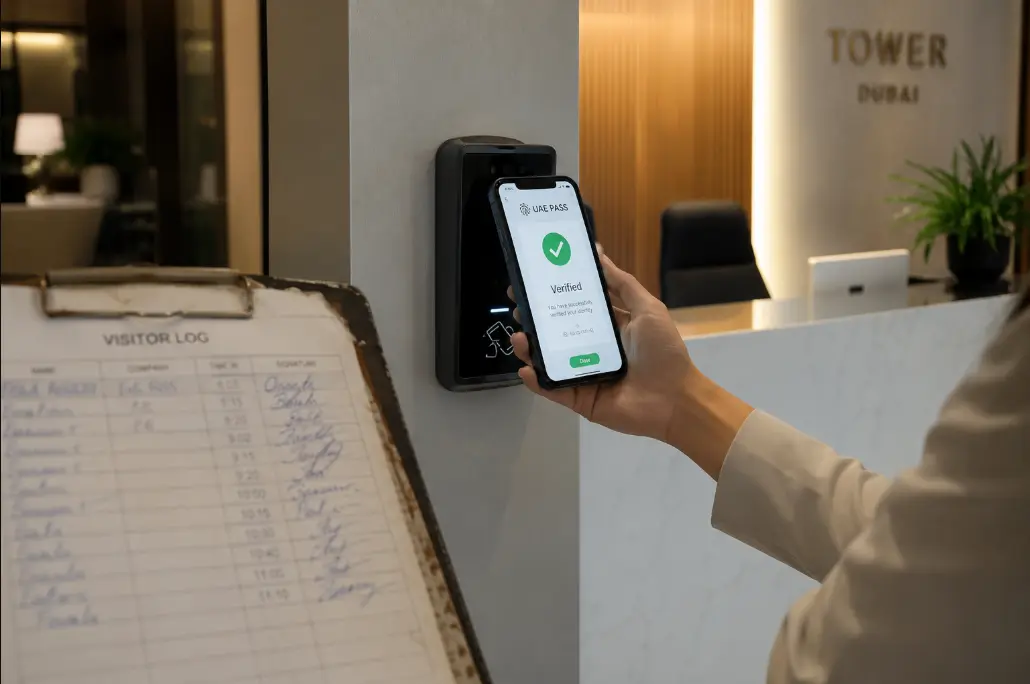
For UAE property managers, that gap is not abstract. It shows up at the gate every day: paper visitor logs, unverified IDs, and manual check-in processes that rely entirely on staff judgment. Visitor management UAE facilities still operating this way are not just inefficient; they are carrying a measurable security liability dressed up as a system.
This is the identity security gap: the distance between what organizations think their access controls are doing and what is actually happening at the perimeter. Perceived security, the feeling that a clipboard log or a photocopied passport is "good enough", is precisely what bad actors exploit. In today's IAM (Identity and Access Management) landscape, confidence without deployment is not a posture. It is a vulnerability.
Multi-factor authentication and FIDO2-aligned standards exist to close that distance. Adoption requires more than intent, though. It requires infrastructure built for the physical world, not just the digital one. That is where MyGatePass bridges the gap, translating enterprise-grade identity standards into a streamlined access control platform designed specifically for UAE properties.
Confidence in a security policy is not the same as security. The gap between the two is where breaches happen. Which raises the obvious follow-up: what exactly makes a paper logbook so risky?
Why are paper visitor logs a security liability?
Paper-based visitor logs and unverified ID checks are not just inefficient; they are a liability that modern IAM security frameworks are specifically designed to eliminate.
For most UAE property managers, the front desk has historically been the weakest link. A visitor signs a paper log, shows a physical ID that staff cannot validate in real time, and walks through. There is no audit trail, no biometric confirmation, and no way to flag a fraudulent identity before access is granted. In multi-building environments, that exposure multiplies fast.
The failure points are consistent across sites:
- No real-time validation: staff cannot confirm a document is genuine at the moment of entry
- No tamper-resistant record: handwritten entries can be altered, removed, or simply left blank
- No cross-site visibility: each building keeps its own log, so patterns across a portfolio go unseen
If your building still relies on paper logs and visual ID checks, every visitor entry is an unverified risk. The standard built specifically to remove that risk is worth understanding properly, which is where FIDO2 comes in.
What is FIDO2 and how does it apply to physical access control?
FIDO2 replaces passwords and manual ID checks with cryptographic proof tied to a device or a biometric, which is exactly what a gate needs.
FIDO2 standards, short for Fast Identity Online 2nd Generation, form a global authentication standard. For a non-technical facility manager, the practical meaning is straightforward: a visitor's identity is verified through something they are (a fingerprint or face scan), not something a staff member assumes. That verification happens instantly, without a paper trail anyone can forge.
Biometric authentication becomes particularly powerful at physical gate management. Rather than relying on a guard's judgment, the gate itself enforces policy: only verified identities pass. Integrating this approach with UAE Pass, as outlined in these verified access control guides, gives facility managers a compliance-ready layer that satisfies both security and regulatory requirements.
Standards do not deploy themselves, though. The next question is what this looks like as a working platform inside a real property portfolio.
How does MyGatePass close the identity gap with UAE Pass?
MyGatePass addresses the identity and access management (IAM) gap head-on by combining UAE Pass biometric verification with a unified digital network built for multi-building property portfolios.
Where the sections above outlined the risks of paper-based systems, this is where the practical answer takes shape. MyGatePass connects every gate, entrance, and building within a property portfolio into a single platform, centralizing visitor history into one administrative dashboard. Property managers get real-time visibility across all access points, with no chasing paper logs and no blind spots between buildings.
The UAE Pass integration is the security core of the whole system. Every visitor is verified against a government-issued digital identity before they step foot on the property. This is not a basic ID check. It is cryptographic verification tied to a national biometric database.
UAE Pass verification means every entrant carries a credential that cannot be borrowed, forged, or forgotten.
Mobile-first pre-registration completes the picture. Visitors register before arrival using their smartphone, so access approval happens in advance rather than at the gate. Queues dissolve. Security staff shift from manual checking to exception handling. If you want a detailed breakdown of what 2026 compliance looks like in practice, the implementation requirements are significant but achievable with the right platform in place.
The strongest access control systems do not just log who enters; they verify who they are before the door ever opens. What that produces in measurable terms is covered next.
What results does 100% digital verification actually deliver?
MyGatePass delivered 100% digital verification across every entry point, eliminating unverified walk-ins and replacing paper logs with a fully auditable, biometric authentication trail.
The headline result is exactly what it sounds like: every entrant verified, every time. By tying UAE Pass biometric authentication to the access workflow, property managers no longer rely on staff judgment or easily forged documents. The system confirms identity at the source, before the gate opens. And because mobile-based visitor management eliminates physical paperwork and reduces long queues at security gates, the operational lift is real on both sides of the security desk.
The measurable outcomes break down as follows:
- Verification coverage: 100% of entrants verified against a government-issued digital identity, with no unverified walk-ins
- Check-in speed: visitor check-in time dropped by over 70%, resolving in seconds through a pre-registered digital invite and a biometric confirmation
- Compliance posture: a timestamped, tamper-resistant record of every access event, matching UAE digital security mandates that increasingly expect verified digital identity trails
That speed does not come at the cost of rigor. It comes from removing friction that never added security value in the first place. Residents and tenants feel it too. Knowing that biometric certainty, not a clipboard, stands between their community and an unverified visitor builds a different kind of trust.
If your current access system cannot produce a verified digital identity record for every entrant, you have a gap. The practical priorities for closing it are set out below.
What should UAE facility directors do next?
The identity security gap is not theoretical. It is a measurable risk sitting inside your current access control deployment right now.
Building on everything covered above, the case for action comes down to four concrete realities every UAE facility director should act on:
- Audit your confidence gap first: a FIDO Alliance and HID Global study found a significant disconnect between how secure organizations believe their identity systems are and how secure those systems actually are. Run an honest audit before assuming your entry points are covered.
- Treat FIDO authentication as the baseline, not a premium upgrade: passkeys developed by the FIDO Alliance eliminate password-based vulnerabilities entirely, and passwordless, phishing-resistant access is quickly becoming the expected standard for physical and digital environments alike.
- Make UAE Pass integration non-negotiable for high-security assets: for residential towers and commercial properties operating under UAE regulatory expectations, government-verified biometric identity is the floor, not the ceiling.
- Treat digital visitor history as core IAM infrastructure: searchable, timestamped access logs do not just support incident response; they demonstrate compliance and accountability to stakeholders, auditors, and regulators.
If your current system cannot answer "who entered, when, and how their identity was verified", it is time to close the gap. The research behind these conclusions is listed next.
Where can I read the research behind this case study?
The research and platform documentation underlying this case study reflects a growing industry consensus: verified digital identity is no longer optional for modern facility management.
The following sources informed the analysis, statistics, and conclusions presented throughout this article. For UAE facility directors seeking to validate the findings or explore the technical depth behind UAE Pass integration and credential verification, these references provide authoritative context.
- FIDO Alliance and HID Global, 2024 State of Identity Report: foundational research revealing the gap between organizational confidence in identity security and measurable reality, available at the FIDO Alliance website.
- FIDO Alliance, Passwordless Authentication Research: FIDO Alliance research tracking the mainstream adoption of passwordless and mobile credential frameworks, with data on authentication trends relevant to physical access deployments.
- Security Magazine, Physical Access Control Trends: industry trend analysis covering the accelerating shift toward mobile and biometric credentials across commercial facilities.
- MyGatePass platform specifications and UAE Pass integration guide: internal technical documentation governing credential verification workflows, visitor management protocols, and compliance alignment for UAE property deployments.
If your facility is still relying on unverified walk-ins or paper logs, the evidence is clear. The time to close that gap is now.
Key Takeaways
- Only 13% of organizations have deployed passkeys at scale, so most access control confidence is not backed by verified deployment.
- Paper visitor logs fail on three fronts: no real-time validation, no tamper-resistant record, and no visibility across a portfolio.
- FIDO2 replaces passwords and manual ID checks with cryptographic proof tied to a device or biometric, so the gate enforces policy instead of the guard.
- MyGatePass connects every gate and building into one dashboard, with UAE Pass verification against a national biometric database as the security core.
- Mobile-first pre-registration moves approval ahead of arrival, shifting security staff from manual checking to exception handling.
- The deployment reached 100% digital verification at every entry point and cut visitor check-in time by over 70%.
- Timestamped, tamper-resistant access records satisfy UAE digital security mandates and give auditors a defensible identity trail.
Last updated: 21/08/2026